
| Home | Nature Diary | Flora | Fauna | Fungi | Events |
| Rugs | Dogs/Cats | Smallholding Devon | Smallholding Cornwall | About |
| 2024 | 2025 |
| << December 2025 | January 2026 | February 2026 >> |
|
1st: New Year Plant Hunt Every year the Botanical Society of Britain and Ireland run a New Year Plant Hunt - designed to monitor how many plants are flowering this time of year and so gauge an understanding of our changing climate. This was our haul today. The hunt runs from the 1st to the 4th so we will keep checking until Sunday. The recent cold snap has killed off a few others that we were seeing, namely thistle, bramble, red campion and blackthorn! This 'proper' winter weather is most welcome. Dandelion  Gorse and Hogweed 
 Meadow Buttercup and Angelica 
 Corn Chamomile and Hedgerow Crane's-bill 
 |
|
2nd: Busy Blue Tits Spent a delightful few minutes watching a pair of blue tits in our inner hedgerow (from Goat field) this morning, as they 'teep teeped' their way around the mossy covered branches, looking for tasty morsels to keep the cold at bay! And our 'eighth' Plant Hunt find: a somewhat bedraggled Mallow - sheltering in the mound by Firefly's 'pond' in Swallow field - as more frosts take hold, don't think it survive much longer!     |
|
3rd: Our perfect corner The bottom corner of Oak field is a very special place. It was here we stood back in the summer and counted over a dozen species of butterfly without moving a foot. It's a fabulous corridor between us and Cadbury Wood where we see all manner of birds including stonechats, treecreepers and wrens. It's often very sheltered and in late spring bursts into colour with Lesser Celandine and Trefoil. Sitting on the bench is a perfect place to catch the warmth of the sun, even in winter (we sat there on New Year's Day and really felt some heat). And we just adore the shape of some of those trees. Photos below are the best from a quarter of an hour at the Bird feeding station (not the greatest shots) and an eighth species for the New Year's Plant Hunt (which ends tomorrow). It is a periwinkle, not native to the UK, but now deemed as 'naturalised'. We are not actually sure we have ever seen this particular plant (just at the top of the allotment) NOT in flower (bit like gorse).   
 |
|
4th: Growth amidst the frozen land Everywhere was pretty much frozen this morning after a splattering of snow and below zero temperatures hit us last night. The land just looked stunning. And still we see growth: we noticed docks with new leaves and nettles where the new leaves were emerging from the dead stalks of last year!! 2025 was, according to the Met Office, the hottest year on record ever and this despite the last week of it having 'normal-ish' winter temperatures. Climate change is happening before our very eyes and some parts of nature are getting a tad confused. We had a total of nine flowering plants for the Botanical Society of Britain and Ireland's New Year Plant Hunt this year but when we entered the data, we were told that four of them are not the 'usual' species recorded, i.e. for them to be flowering now is not expected at all. The four in question are: Wild Angelica, Corn Chamomile, Hedgerow Crane's-bill and Common Mallow. We sent in photos (as above) as evidence and wait for verification. 
          |
|
5th: More Frozen landscape Plus a fab video of one of our foxes drinking from a frozen Fruit Pond last night       |
6th: Bird Feeding Station


 |
|
7th: Brave flowers We are now snow and ice-free and some of the plant life has heaved a sigh or relief. The dandelions are extra ordinary - there hasn't been a day when we haven't been able to find one in flower. The Corn Chamomile is similar and today we spied new flowers that look ready to open out as soon as a bit of warmth hits them - which possibly won't be any time soon: heavy rain and strong winds are due tomorrow!! Meanwhile, our winter skies continue to be spectacular.    |
|
8th: Siskins are back Delighted to see our siskins back at the feeders and they are certainly giving the goldfinches a run for their money. Meanwhile, Jelly spot and Turkeytail fungi have come through the frost, snow and ice and are looking as fresh as ever!! 


 |
|
9th: Robins and Willow Being serenaded by a Robin is pure magic. They make you feel very special, as though out of all the people in the entire world, they have, at this exact moment, chosen only you to sing to. We expect we all have 'our' robins - and we are thankful for every single one. Also pure magic was a morning with willow with the supremely talented and patient Gemma Ansell-Nelson today at The Craft Room - Workshops & Supplies here in Chulmleigh. We made wreath supports, stars and a beautiful fat ball feeder for the garden. Jack is very much NOT a natural crafter but Gemma's tuition ensured she came home with three items she is very much proud of!! Cannot recommend these craft workshops enough!! Aren't we lucky to have these on our doorstep? Check out what else is on this month and beyond 


 |
|
10th: Water droplets Had fun today with the Macro lens taking shots of water droplets on the hawthorn at the bottom of Oak Field. Some were frozen, producing some really weird effects. It was also a joy to watch this female blackbird enjoying the berries just by Fruit Field shelter, Much as we love feeding the birds, it is also great to know that the land is providing for them as well.      |
|
11th: It only took an hour!! We made the fat ball feeder on Friday (9th), hung it up first thing on Saturday (10th) and within a mere hour, the first blue tit started to use it!! Watch the video to see the other visitors we had. (We collect the cards from the trail cams every 24 hours, hence only seeing the footage today.) |
|
12th: Fungi and Blue Tits Still spotting new fungi - here we have some teeny Angel's Bonnet found on a dead piece of bramble stalk under the Ash tree by Yeti's gate and what 'may' be a new species to our land - Smokey Bracket - we need to check the underside and make sure it is grey. It's in the outer hedgerow in Oak though and quite far into the ditch - access may be a tad tricky!!    And in the video we can see that the numbers of Blue tits are starting to rival the Goldfinches right now. Plus we spotted our first Greenfinch of the year back at the feeders this week which is fabulous news. |
|
13th: Spindle Jo and Paul gave us this spindle tree last autumn (it was too big for their garden and wasn't doing that well where it was) and we are cautiously optimistic about its future with us. There are a lot of new buds and a brand new shoot from below the soil. Fingers are being crossed as we type. 
  |
|
14th: At the Bird Feeding Station This is the usual sight first thing in the morning before we top up the bird feeders: a mass descent as the goldfinches, in particular, rush to get to the last of the seed. The trays are proving fabulous as they act as another feeding area instead of the seeds falling to the ground and starting to rot before they all get eaten. And any that does fall, gets hoovered up by the ground feeders. Sunflowers are, without doubt, the seed of choice, and the waste here is negligible. The mixed seed not so. We have started to put out more sunflowers than mixed seed now and just hope that all the individual species are all still getting what they need. |
|
15th: Pond LIfe We took a torch with us this evening and headed for Poultry Pond where we spied oodles of palmate newts (and possibly some Common) and a mating pair of frogs plus the biggest Great Diving Beetle ever. Also zillions of water boatmen - think nightly torch visits are now going to become a thing - we are also setting the moth trap this Friday night as it is meant to be dry!! We have been seeing moths in the trail cam videos of the Green Lane at night so are optimistic we might catch something. Feel things are really beginning again and it's very exciting. 


 |
|
16th: Foxes, Lichens and Trees We were very chuffed to see both our foxes on the Trailcam footage from a few nights ago - proof that they are both still around. We wonder if (hope) these are a male and female and of course the bigger question is whether she is pregnant. The gestation period of a fox is 7-8 weeks and most cubs are born in March/ April, thus mating season is most definitely now. A few nights ago we heard the incredible sounds of a fox wailing and shrieking - noises that suggest mating was on the mind!! Foxes tend to pair for life and the dog fox will attend to both the vixen and later the cubs in terms of bringing them food. The 'den' however is not chosen by the vixen until shortly before she gives birth and so whilst we know that our middle hedgerow is a place the pair frequently enter and exit from, any cubs may not be born there. We will simply have to keep the trail cams going and see what we will see. There are several brilliant articles here about fox mating, breeding and general behaviour. In other news, we spied a spectacular specimen of what we think may be Cladonia chlorophaea, the False Pixie Cup Lichen (there are a fair few similar species so it is considered to be part of an aggregate group). We found it growing on a fence post on the garden/viewing area fence and was in prime 'fruiting' condition. And lastly, after the weather being too wet, then us having coughs, then the land freezing.. today we finally planted Lynn's trees in the first bank in Fruit field. These have all come from her mum's garden and we are mega chuffed to have them. They are mostly birch, with one beech and two or three sweet chestnut. So 'Lynn's bank' is now officially launched!! 


 |
|
17th: Mallards The trailcams are picking up our pair of mallards quite a lot now - Chaser pond seems to the place to visit at night and judging by the female dabbling gong on here, they are finding things to eat. They eat seeds and water vegetation as well as pond invertebrates. We are happy to see them although aware they will never nest here with the dogs around!! But if it is proving a useful nighttime foraging area, we are delighted they have chosen us. Mallards (in keeping with other ducks) will often do a lot of feeding at night as that way they can avoid disturbance and predators and eat more safely. They will then return to more open water for daytime roosting! It may be that they have chosen us for the winter - time will tell!! |
|
18th: Pinbroidery with Jo Everitt, making hand-stitched wildlife cards A fabulous pinbroidery workshop led by the amazing Jo Everitt today . Pinbroidery involves using a template to prick holes into a blank greeting card and then stitching with an embroidery thread to create your picture.Fine motor skills were needed (and in Jack's case reading glasses) but as we stitched and our harvest mouse appeared in front of our eyes it was so rewarding. (And thanks to the group for all these fab photos.) .jpg)
.jpg)
.jpg)
.jpg)
.jpg)
.jpg)
.jpg)
.jpg)
.jpg)
.jpg)
.jpg)
.jpg) |
|
19th: Water droplets Fun with the macro, moss, lichen and dock      |
|
20th: White and grey Damp, windy and grey - but then we spied our first snowdrops in the garden!! There is always something to lift the spirits!    |
|
21st: Herons Our Grey Heron is now becoming a bit of a regular feature. We catch it on the trailcam just occassionally but enough to know that it is motivated enough to keep coming back. Our ponds are rich in life as the blog on the 15th showed - and of course frogs are now starting to appear in more numbers too (not that we want it to eat too many of those). As well as the Grey Heron, there are also a few Night Herons in the UK. They are as scarce as the Grey is common, but we had the privilege of seeing some in a location in Devon last year as whilst a scarce migrant, some are now breeding in this country. Images below the video.  
 |
|
22nd: Siskin Beautiful view of a male Siskin on the feeder today - and don't blink cos you will miss the Greenfinch flying in and then out! |
|
23rd: Fungi and lichen in the wet It's all very wet at the moment but in the gaps between the rain, we have been finding more fungi and enjoying starting to get to grips with some of the lichen (far more difficult to ID). Reading about the life cycles of these amazing organisms, is a lesson in humility. Nature really works things out for the benefit of all, nothing is done without reason and energy isn't wasted. Humans have it all wrong so much of the time! Variable Oysterling - Crepidotus variabilis: very common on our land and possibly one of our favourite fungi. It grows on decaying wood and is definitely not edible. 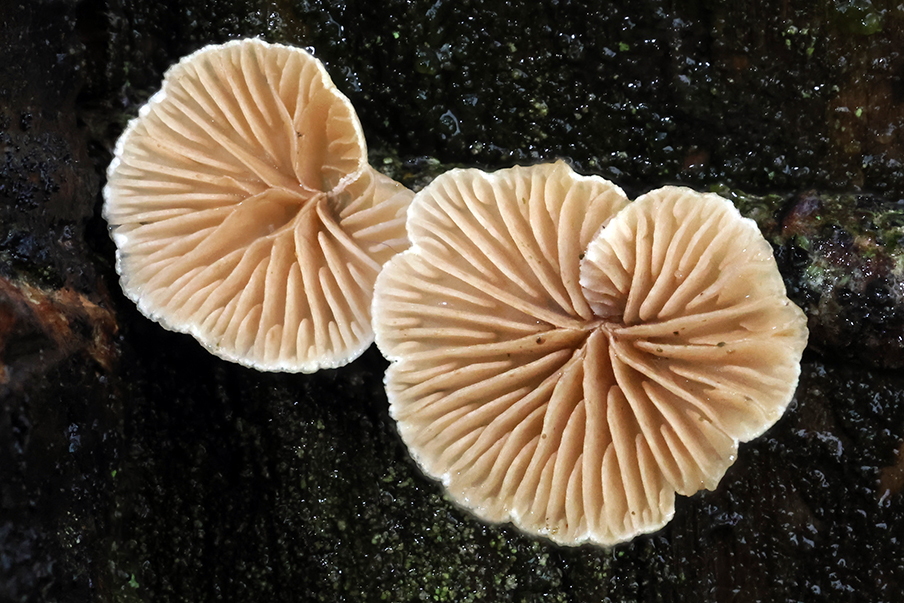 We 'think' the left hand photos is Jelly Rot Fungus - Phlebia tremellosa: another wood decaying species that turns orangey pink with age and is apparently edible (not that we would ever try eating any fungi we had ID-ed). The lichen on the right is a Punctelia we think, but not sure which - we have much to learn 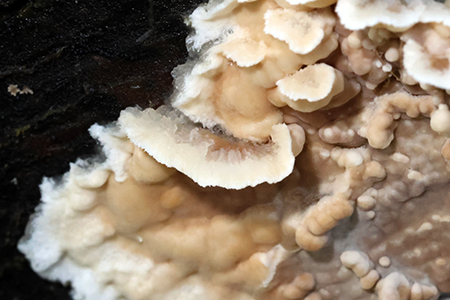 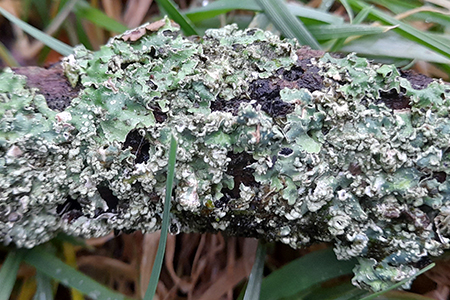 Two more lichens: Parmotrema perlatum - very common, growing on bark, rocks and even the ground; grey when dry and green when damp (this is a definitely a 'damp' version) and finally the Common Orange Lichen - Xanthoria parietina: again very common and, as the picture shows, not always orange. In text copied from NatureSpot.org: 'The yellow chemical xanthorin is thought to be produced as a defence against UV radiation to which it is exposed in its normal habitat - cement tiled roofs, exposed twigs and branches etc. When it is growing in the shade it does not require such protection and xanthorin production stops and the lichen remains green. In or after rain, this lichen appears more greeny yellow as the algae shows through the more translucent fungus.' It's all quite fascinating!! 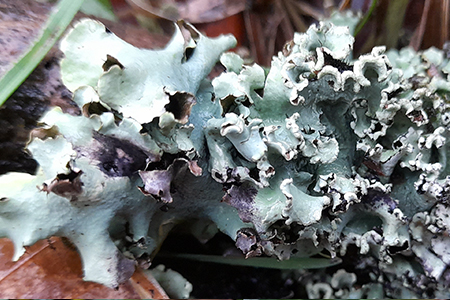 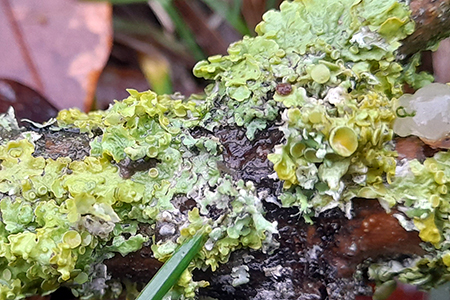 |
|
24th: Rain The recent rains are certainly filling up the ponds again - these are Little Chaser and Chaser, the former now overflowing into the latter, with Chaser itself being fed by 'Firefly's Stream' coming down from the middle ditch. The two in Swallow field are still aren't doing that well - just a few puddles in the bottom.. but we live in hope... 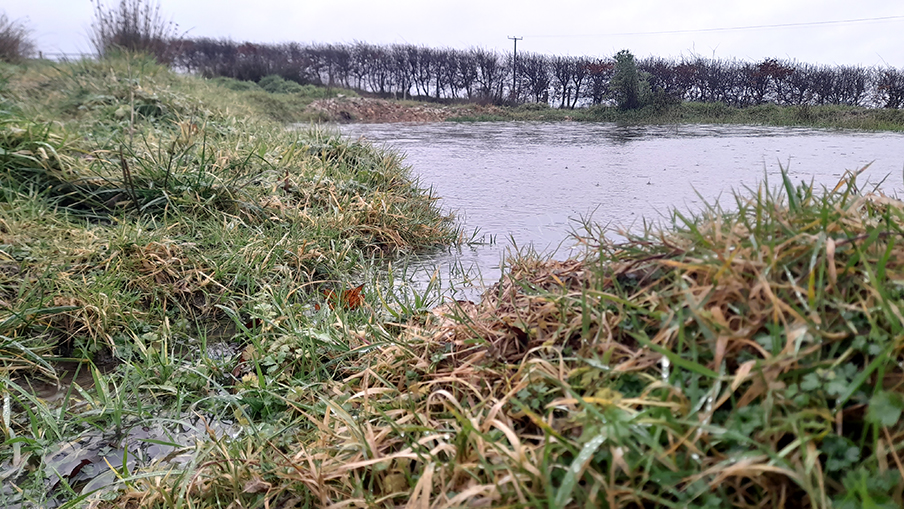 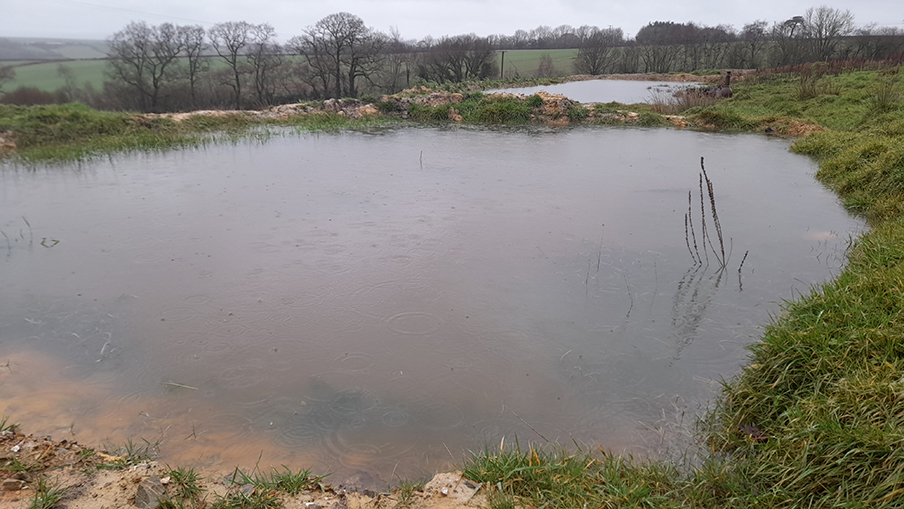 |
|
25th: RSPB Garden Birdwatch Today was the RSPB Garden Birdwatch. It is our second year of taking part and as the numbers show, our totals are down - it wasn't great weather mind you and last year it was drier. We are down four species but up three, so a net loss of just one!! These snapshots are great but for an individual garden, they don't really tell the full story. So, we know that our starling numbers are much greater this year and they are far more frequent visitors to the feeding station. The nuthatch is a more frequent visitor too but just didn't appear when we did our hour's count. Overall, on our land generally, we are have seen more species of birds and in greater numbers than we were a year ago - BUT unless we recorded everything on a daily basis, these 'facts' are all just anecdotal. It will be interesting what the overall numbers across the UK are like as the RSPB compare 2026 with previous years. In other news. we have some very full ponds and the sound of running water in our ditches and ephemeral streams. 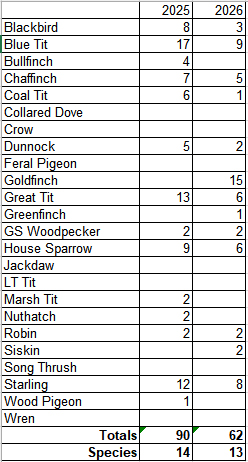 Chaser and Oak 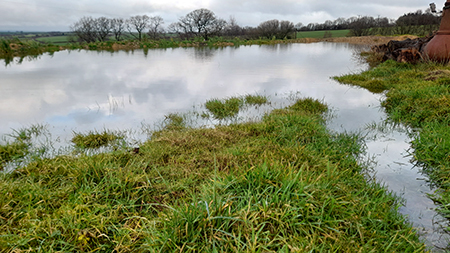
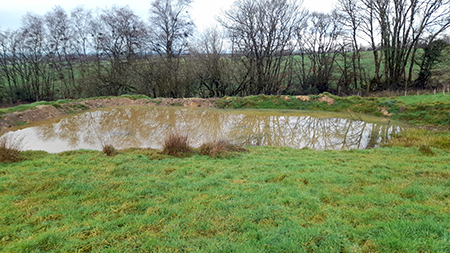 Yeti's stream into Little Chaser 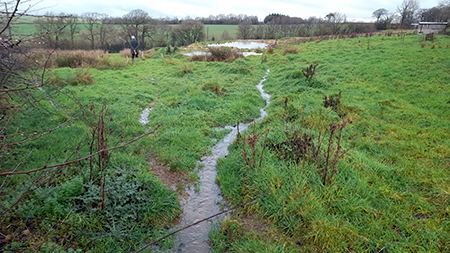
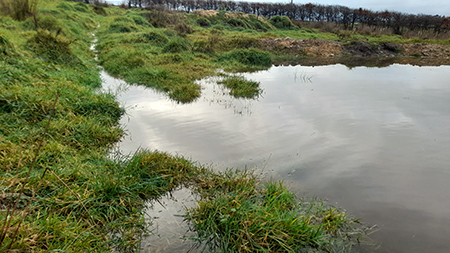 Fruit Pond and Poultry Pond 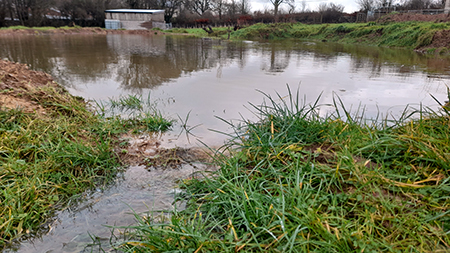
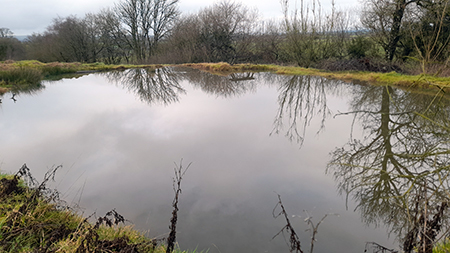 |
|
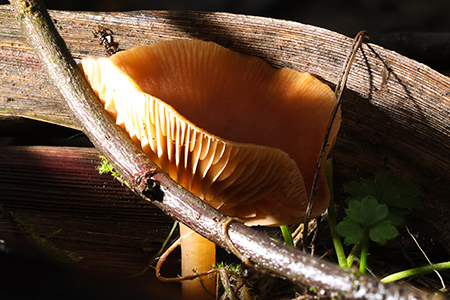
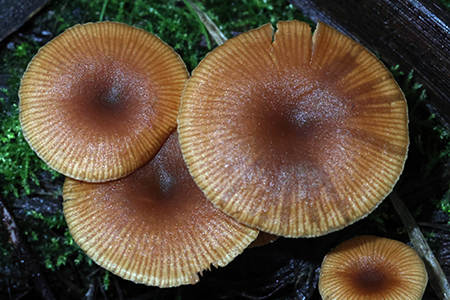
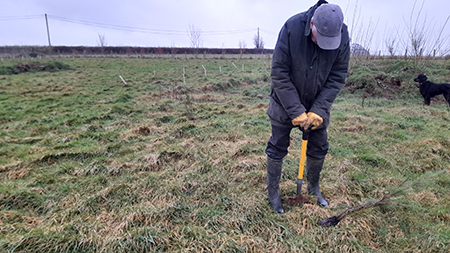
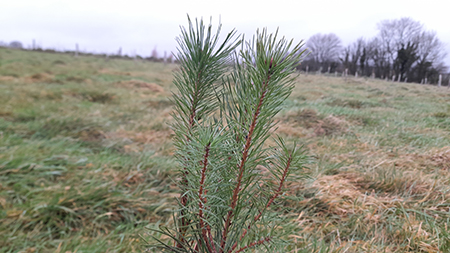
26th: New Species Today we found two new species of fungi: Scurfy Twiglet - Tubaria furfuracea (what a name), was found growing in our big Wren brash pile at the top of Goat field (so called because it is a favourite of the wrens). There were many of them, all looking very new and pristine. They are apparently hygrophanous (changing colour according to the moisture levels) and become more ochraceous as they dry out. After the rain we have tonight, we wouldn't be surprised if they are much darker tomorrow. The second are Wood Oysterlings - Deconica horizontalis, a small fungus that is partial to growing on pallets.. which is exactly where we found it, on the pallet compost heap in the allotment. Until you look underneath, you have no idea they have a stalk. We finished the day with more tree planting: ten Scots PIne are now in Fruit field, in a curved line in the middle - once again they were free (thanks to Amy Roberts from the Biosphere). 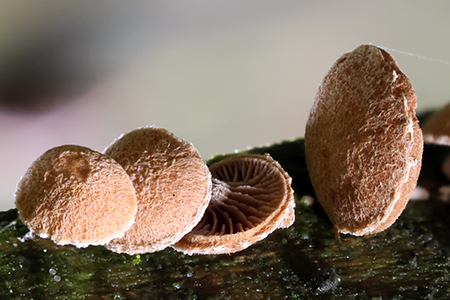
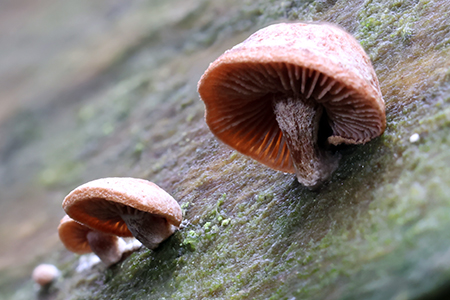
 |
|
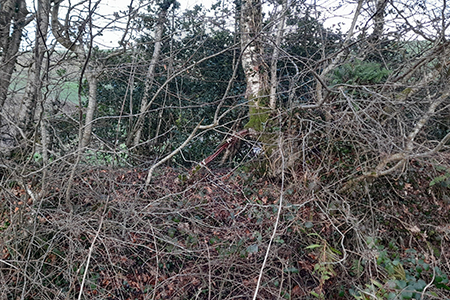
27th: A LOT of water The rain last night was immense and we awoke this morning to some very full ponds. Small Chaser was overflowing into Chaser AND Chaser was overflowing into the Clay Pit which, for the first time ever, was almost full. We have done some puddling at the bottom of the Clay Pit this winter, and we believe this has been making a difference to its ability to retain water. Time will tell!! Both Poultry Pond and Fruit Pond were also overflowing. Oak Pond disappointingly was not full and as it is fed by the spring, as well as being at the bottom of Oak field, we continue to be of the opinion that it is still leaking somewhere. It is holding more water than it used too but it still drains a little too quickly after heavy rainfall. Goat pond and Rabbit's pond are as full as they have ever been, although Rabbit pond still has a long way to go to get to the top. And finally, we have Swallow and Yeti ponds - Yeti's is looking good, the fullest it has been we think. Will these two finally start holding water. At the end of the day, no matter how full or empty these ponds are , they will all make great habitats for a variety of animals and plants. It would be nice to see the banks a bit more covered this year mind you! Finally, finally, the final pictures depict an interesting branch formation from one of the silver birches in the bottom hedgerow in Oak. It looks as though a thick branch growing from the main trunk (and possibly from a knot/ where an old branch one was), has then anchored into the ground. Subsequently the bark has peeled away to reveal lots of smaller branches, partially twisted. If you look at the branch where it comes from the main trunk and also where is enters the ground, you can clearly see the full bark. We posted these pictures on the NHM Biodiversity FB page and one explanation was that it might be 'adventitious roots'. These are roots that emerge from non-root tissue, such as stems, leaves, or branches, rather than the primary root system. In trees, they can appear due to stress, waterlogged ground or as an additional support when the tree is damaged. Quite why they have appeared here, we are not sure. Chaser Pond 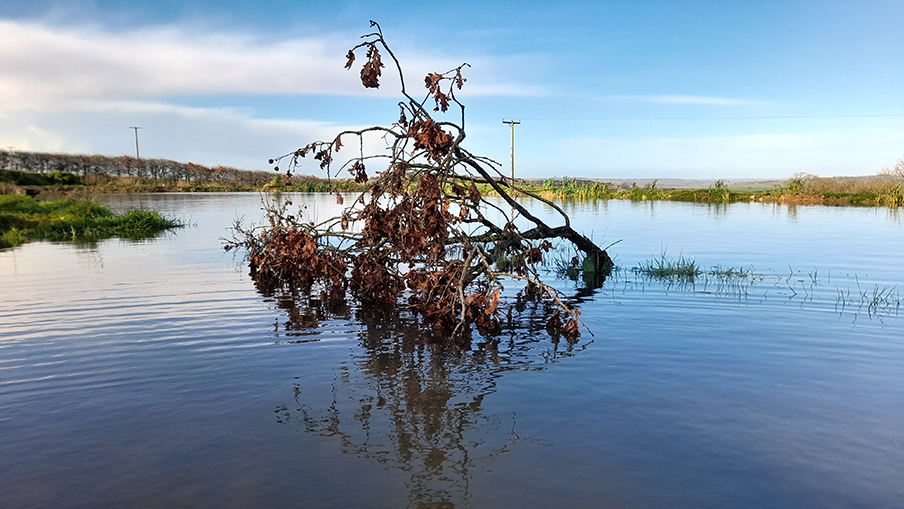 The Clay PIt and Chaser 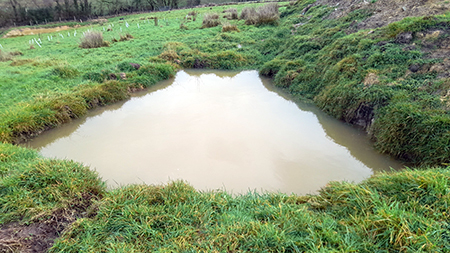
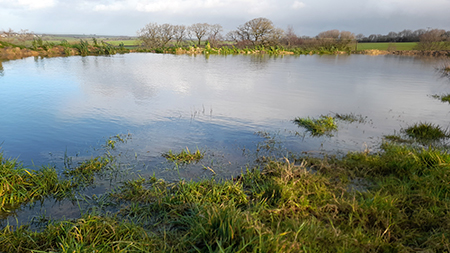 Both Chaser ponds and Fruit pond 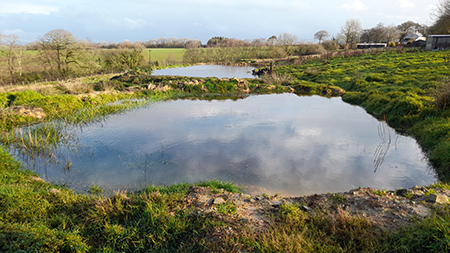
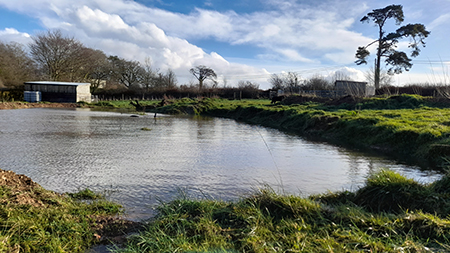 Yeti and Swallow ponds 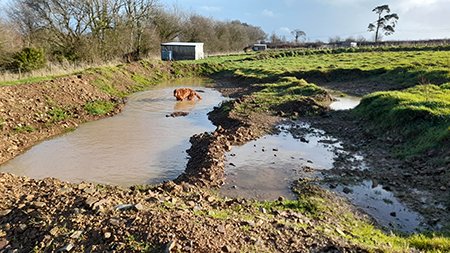 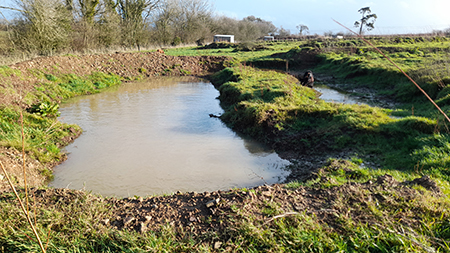 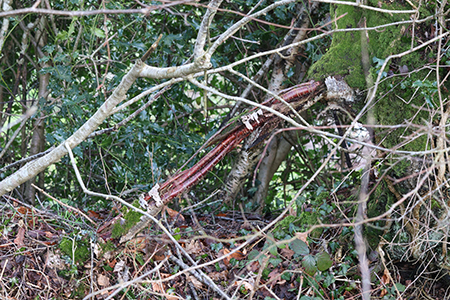
 |
28th: Moody skies and full ponds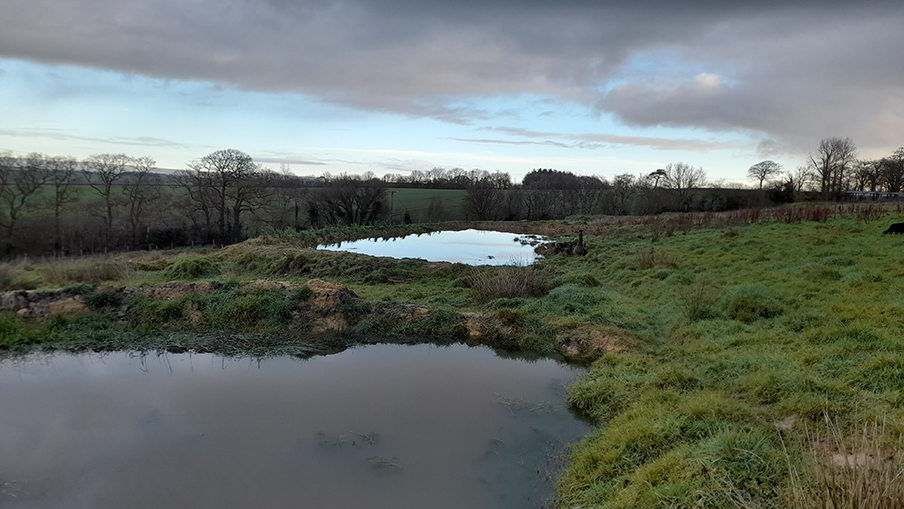 |
|
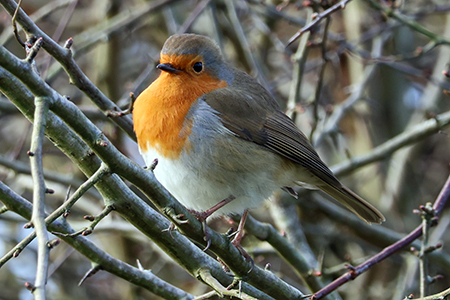
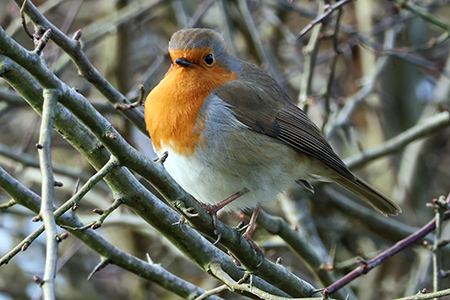
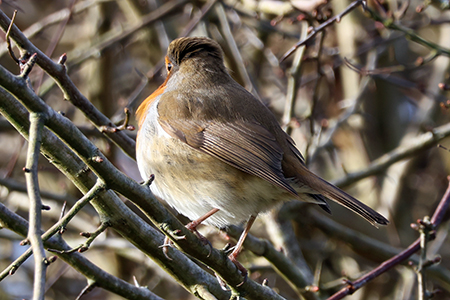
29th: A tonic admist the grey and damp Another wet, damp day - the South West has had some pretty terrible flooding this week and lots of lives have been very disrupted. No photos today, so instead we have our cheery Oak field Robin who came to say hi two days ago. 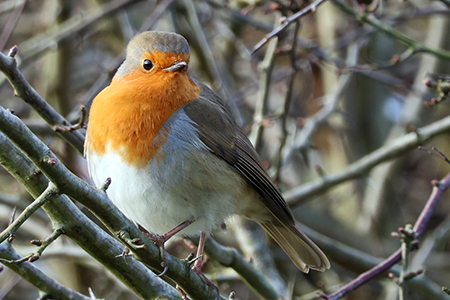
 |